Showing posts with label Huck. Show all posts

Thursday, 3 June 2010

The Ocean


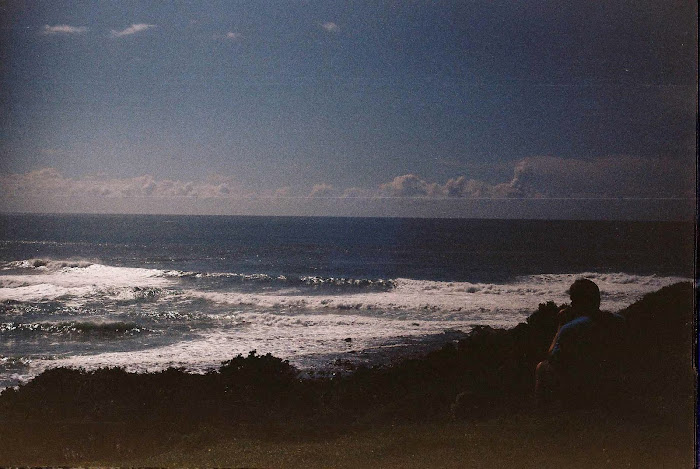
I’m writing this from my ocean side apartment in Kalk Bay, Cape Town, looking out over the expanse of blue that is False Bay. Everyday I rise to this most effortless of backdrops, its ever-changing moods marking the passage of the days and seasons. As city life unfolds so uncomfortably around me, the changing faces of the ocean keep me grounded and I can start my day in peace. I owe this to the sea. Without it I would be lost.
I was too young to remember my first experience of the ocean, so I will tell it as my father recounts it to me. Growing up inland, we would head to Cornwall every summer, where we’d swim and sail and bodyboard. It was a family ritual, my grandfather would make the same pilgrimage with my father long before I was born and the M4 motorway heading west from our home to the seaside had been built. Theirs was a 16 hour trek across rural Britain with a caravan in tow, getting stuck on single-track hills until the local farmer arrived.
My grandfather would make bodyboards for the family, bending and shaping the wood using the weight of his car, then varnishing and finishing them in time for the summer. These same boards we grew up surfing with as kids, relics from a bygone era, and my father recalls the day he looked up in surprise to see me dragging a huge rented foam mal down to the water’s edge. From that moment, the wooden boards became forgotten family relics and the ocean became my obsession.
For me, the most significant time was the day I got my licence. I’d stay at my friend's house, it’d be 2am and we’d make the modern day three hour charge down be the motorway, frothing at the possibility of waves. These were the days before internet forecasts so we’d just go in hope. Some days it would be on fire. We’d surf all day and stop only to eat. Other days, it would be junk but we’d surf just as hard. Often, we’d sleep on the beach too. I remember once waking to dolphins playing off Treyarnon Bay near Padstow. It was sometime around 5am and a tractor was tilling the sand in the early morning light. I suited up and jumped in without a soul in sight. This was freedom on a new level and we lost ourselves in the object of our deepest desire.
As the single-mindedness of my teenage wave lust waned, so my appreciation for the ocean changed and I found myself becoming increasingly introspective about my surfing and what it meant to me. Through my obsession, I’d become increasingly ostracised from the circles I had grown up in and I began to feel increasingly ill at ease when land locked. The world I’d found at the ocean’s edge atrophied beneath the rotten concrete and asphalt of England’s cities. I began to realise it wasn’t just the surfing I missed, it was the ocean and the communities that thrived off it. In them, I could see myself.
Increasingly, I was drawn to the road in search of something different. I avoided the main surfing hubs and instead ended up in Peru, Ecuador, Northern and Southern Africa and the Western Sahara, spending time in some of the most impoverished yet wonderful and welcoming communities I’d met. We were united through our love of the ocean. It broke down the cultural differences that existed between us and allowed us to interact as friends with a common bond. I remember the fisherman in Peru, sharing with me his fish head stew by candlelight in his threadbare mud-brick cottage. He was picking the flesh from the gnarled jaw and sucking the eyeballs as the fillets had been sold at market so he could educate his children. A simple existence forged from the ocean and for which he gave thanks each day in prayer. He was happier than any man I’d met. And for every country I visited, there was another such example. All happy, all giving thanks to the sea - the great provider.
It was around this time I graduated and I was free to make my own path. I’d become deeply uncomfortable with the society I was in and the selfish and materialistic mindset it encouraged. Success was assigned a monetary value and drive was the key to achieving top dollar. And for what, I couldn’t quite see. Everything it extolled, I had found the opposite by the sea, and there I’d also found happiness. But I ceded to pressure, the responsibility to consider a future.
I tried for a short time to fit in in England’s industrial core but what I found was all I feared; materialism, indulgence, selfishness. It left me depressed and devoid of life. I longed for a return to the beach and the open water as there I found context and reason. It gave me simplicity, honesty and a tangible link to the natural world. The city was fake, artificial, a graveyard to the soul. The freedom I sought, I found on the natural fault line between ocean and land.
Today, the ocean is a part of me and indelibly so. It’s impossible to articulate a respect that runs so many fathoms deep. The lessons I’ve learned stretch far beyond the shoreline and have reached deep into my life. I cannot imagine a life without the sea, yet I still know so little and there’s so much still to explore.
In the ocean, I see life in all its beauty and fragility, and all of which I lost in the city whose lights extinguish the stars above and whose concrete smothers the earth below. In the sea’s constant flux I see spontaneity and renewal: the ebb and flow of the tide, the reshaping of a sand bar, the arrival of a new swell, the coming of the basking sharks at Harlyn Bay, the arrival of the Southern Rights during the winters of Cape Town. The ocean is alive and in delicate balance, where days unfurl and are subject to the chaos of the passing elements. Yet life in all its resilience wins through. It is here I find comfort in moments of doubt, assurance that I will be OK.
As I look out over the ocean at the day’s end, I am humbled.

Wednesday, 26 May 2010

Politics - South African style


As you head east out of East London on the Eastern Cape of South Africa and rejoin the N2 national highway, you descend through fertile green valleys until you reach the muddy brown waters of the Kei River. A relatively new two lane concrete bridge dwarfs the old rusting iron structure that once served as the single track crossing of the R102, guarded by the now decrepit concrete shell that was the border post between the Eastern Cape and the Transkei. It’s an inauspicious crossing these days, perhaps purposely so, and you barely notice the corroded, ivy encrusted iron fence that used to divide white and black.
The Transkei is one of the Xhosa homelands created by the Apartheid governments who cut up and re-drew the South African map, in so doing relocating millions of black and ‘coloured’ South Africans away from their traditional tribal homelands and into large vacant expanses onto which American style block towns were built and heavy industry moved in. Away from the new towns and tar roads, the old small rural communities remained where the traditional tribal way of life of the generations before was continued with emphasis of self-sufficiency and self-governance; a way of life that still continues today. Exit was not permitted without correct paperwork and ID, to be caught outside the border without sufficient identification meant an immediate return. It was only in 1994 that the border post was decommissioned and movement between the Eastern Cape and Transkei was freely permitted.
It’s election time in South Africa and registration was in early February. Those with ID books signed up at their local offices whilst the many without did not. As you trundle along the N2, joining the dots between the small settlements that scatter the surrounding empty green hills, you pass endless signboards, banners and posters championing the various candidates for whom there is little hope: The ANC have held an unassailable majority since 1994 when Nelson Mandela took over the presidency. His success; in taking an objective view on South Africa and transcending the injustices of the apartheid governments in the name of all South Africans, has not been mirrored by subsequent leaders who have been more inclined to adopt a more hardline approach. The pendulum analogy is a common anxiety and one which many fear will be realised in full should highly controversial ANC Leader and probable election victor Jacob Zuma come to power when the votes are counted in April.
Championed by the ANC as an uncomplicated and passionate man of the people many fear that Zuma, a loyal and aggressive Zulu of proud working class heritage, will continue the descent from the days of Mandela and move South Africa into a new era where politics will once again be used to marginalise rather than unite. New splinter party COPE (Congress of the People), a result of the recent power struggle between Jacob Zuma and former president Thabo Mbeki, and began by former ANC members loyal to Mbeki and Mandela, offer a credible but ultimately unlikely threat as do the DA (Democratic Alliance) who have had a surge in popularity uniting both white and black voters, but it is the ANC who are roundly expected to keep their absolute majority in the April elections.
Leaving the N2 and pointing towards the hills and coast the roads degenerate, soon becoming little more than dust trails between maize fields and small gatherings of green washed rondavels. Children play innocently in the road; the speed and frequency of the passing traffic poses less of a threat than an opportunity to ask for “Sweeeet, sweeeet”. Men in handsomely cobbled uniforms flag passing pick-up’s for lifts as the signboards and posters of the N2 vanish, as does any semblance of the urban environment inland. Life here is viewed from a very different perspective.
Sitting on a hill early one morning, contemplating a surfless day ahead after heavy overnight rains had swollen the rivers sending brown floodwaters sweeping through the line-up, I meet Meniswa. I watch her idle up the hill in the heat and bid her good morning. Though I am sat in boardshorts with surfboard resting across my lap she mentions she is selling beads and asks if I would like to buy some. I pat my empty pockets and apologise but rather than move on as many of the other local craft sellers would, she drops her bag and sits next to me taking in the morning air as we look out across the bay.
She is 36, though she looks younger, and was born and raised in the Transkei. She is one of 18 children who live with their parents in a small cluster of rondavels at the top of the adjacent hill, marked by a small column of chimney smoke rising through the early morning haze. She spends her days making and selling beads, making enough money to buy bread and rice to accompany the Millies (corn) they harvest from the small field at the back of their huts. If she needs extra spending money she will act as a guide to the local Marijuana plantations hidden in the hills. Though she doesn’t smoke it’s an easy way to make a few Rand and she doesn’t mind relieving the eager tourists of money they are only too willing to flutter.
When I ask if she plans to leave the Transkei she says no. This is her life and was the life of her parents, why would she want to change when all she needs is here? I ask about the rest of her family; her brothers work in the mines north of Jo-Burg but Transkei is home and they always return at every occasion to share their money and honour their family - a trait I have found with most working men I have met in the cities. When I ask her of the coming elections she smiles a soft smile and shakes her head but not in disapproval of the question, it’s clear she pays little heed to politics, family comes first and governing is left to the chief. I am suddenly aware that the ideal of ‘home’ here is far stronger than anywhere else I have visited. The conversation ends and she gets up to go leaving me to trudge the puddle strewn mud path back to my hut and contemplate the simple life.
The more you travel in South Africa, the more people you meet, the more places you see, the more that you are confronted by the huge discrepancies not just between rich and poor but the cultural differences that exist between the different tribes, races and societies of the ‘Rainbow Nation’. The complexities of attempting to govern such a diverse population really hits home as you travel from province to province, interchanging between societies each one the polar opposite of the next, the only tangible link being their South African nationality – a concept only really created in 1994. It’s not just a South African issue, but a problem endemic to African politics. How will politicians who have emerged from the poorest backgrounds and with strong tribal heritage put the needs of a nation ahead of their own people? Their people to whom they are deeply loyal and with whom, have suffered at the hands of previous regimes?
Pride has no place in politics, especially here in Africa. As Barrack Obama cited in his inauguration speech, it’s time to look above and beyond the needs of the individual and to act for the common good. This is the challenge that awaits South Africa’s next president, how he goes about this will determine the future of one of the last peaceful democracies on the African continent.

Volcano days


So for six days, Earth spewed it’s guts and extended to us mere mortals a reminder that we are, and always will be, only human.
The cloud’s gradual precipitation across mainland Europe was really a gift, and I wander if in time we’ll come to mourn its passing. In my highly romanticised opinion, it wasn’t simply an inanimate object but a living, breathing, pulsating reminder of our own existence, the unpredictability of life and the beautiful serendipity of chaos. A poke in the ribs as if to say ‘ Don’t take life too seriously, have a few days on me’.
As stranded tourists made the mad dash for Calais, the Navy awaited in it’s own modern day kitsch rendition ofDunkerque. ‘It’s the spirit of the blitz’ some claimed. Mankind was set to be reunited and rekindled in the spirit of love and kinship, if only for a moment. All it takes is a war, or a volcano. ‘Nah, it’s all just an election stunt’, cried the miserablists.
Back in Sweden, the trains were gloriously blocked and the hire cars all vanished. People, people everywhere and not a lift in sight. From a little island retreat in the Stockholm archipelago, I watched the weather drift through the dreaming spires of the old town with visions of Kerouacflittering in the wings as I contemplated a mad dash across a Europe, now littered with legitimate bums. But the days were bathed in warm spring sunshine that were ushering in colour after a heavy winter, so I decided instead to wander the streets and enjoy this little gift of time.
In a tea garden over cakes and pastries, I met Stina who was hosting her radio show - an open mic session for the disabled where the laughs are real and never self-deprecating. It was real life for all that it is and could be, where there were pancakes with blueberry syrup and cream. Free pancakes that buttered smiles all across the room. Then there were the galleries where I discovered Lee Lozano and her enviable collection of phallus’s and choice use of language. I never knew art could be penises and rude words, never were we taught that at school. Maybe I could have made it after all.
And then the snow came and sifted through the cobbled streets. And with the flurries came Gordana, the Romanian with the kaleidoscope eyes that took me back to the streets of my childhood flicking marbles in the gutter. She took me to a vegetarian café full of arty types. We walked the back streets where she told me of her homeland and the ogre count Dracu who impaled criminals on the street for all to see, from where Bram Stoker drew some inspiration for his Dracula. And somewhere in the cold, a little spark and a memory of tenderness as she held my arm, and I willed the eruptions to continue long into the spring.
And then the cloud shrivelled and we parted ways. The televisions celebrated ‘a swift resumption of normal service’. There were cheers from industry types, ‘hey, we can make money again!’. A swift resumption of routine, a swift return to normality. One of the seats on the flight was mine, and I had to take it, as for me like everyone else, normal life waited. What a downer.
It felt as though for a little while the world woke up from the deepest of slumbers, and we opened our eyes to the skies and our hearts to one and other. For the briefest of moments, we were all alive and well and open to the wonders of the world. And it felt good.
But tomorrow won’t be like today. It’ll be back to reality, and I’ll miss the volcano.

Come fly with me


It (is) the longing, romantic, reasonless, which lies deep in the heart of most Englishmen, to shun the celebrated spectacles of the tourist and without any concern with science or politics or commerce, simply to set their feet where few civilised feet have trod.' - Evelyn Waugh, preface for A short walk in the Hindu Kushby Eric Newby.
I turn the page and glance around the cabin, now dimly lit as we drift slowly into the night that’s been creeping in from the east. Below, the dry folds of the Kalahari have vanished amid mists of high cloud, so I settle into my seat and read on.
When I was a kid, we often travelled by train. I remember revelling in the journey, becoming lost as we crossed into the wilderness between civilisations and immersed in the transition of countryside and culture, never once stopping to read, I hated to read, just staring out of the window as the world streamed past all blurry, longing to be lost. Then we flew, and it was cattle class all the way. Again, I never read, just watched TV. First on the big fold down screens, then on a Virgin flight in the early nineties we discovered the mini TVs. So it was TV and video games whist we sped across the world below until we were served our destination. For all those days in cattle class, I longed to recapture the romance of the train. I longed to be lost again. So today was a little fillip, a testament to one of those old adages.
Two months in a cast after a dislocated knee had been pretty tedious but in my pocket lay consolation. For years, I’ve been crammed and packed into the cheap seats but today I board the plane and turn… left, to the front, business class with torn canvas shoes, missing laces cobbled with ribbon, salt-encrusted shorts and a sun bleached t-shirt.
“Sir,” she said with a smile. “We are delighted to offer you an upgrade.”
I’ve never been upgraded, let alone called ‘Sir’. I could have kissed her.
I should have kissed her.
Regrets soon pass with a champagne welcome. And for the first time, I’m unprepared for take off, engrossed in the orgy of in-flight entertainment in my own personal lounge bed-cum-home cinema; an unaccompanied minor at the age of 28. The engines roar and we are airborne.
The south easterly has blown away the clouds and Cape Town is visible in the evening blue skies. False Bay wraps away to the right, thousands of feet below us as we climb higher and head north, into the Karoo and beyond, headed east out of Africa towards the Middle East. The engines fade and the cabin is wrapped in the warm hiss of passing air torrents. To the west, the sun is beginning to set and the horizon is glazed in deep pastels. Below is Africa: huge, empty and barren. At first, there was Cape Town then mountain passes and fertile valleys until soon the folds and contours submerge amidst the browns of the Great Plains, and all that is visible is a great and empty nothingness. Small dirt roads alongside twisted river valleys lead to lonely and distant farms. Across the plains stretch majestic empty roads, straight for as far as the eye can see, linking nothing to nobody until the fields grow ten fold and giant crop circles, irrigated green against the dirty brown, come hulking into view. And there arrives Bloemfontein and then Johannesburg, out of the desert as we trace a lonely white line overhead. The dark fills in from the east and we pick our way through flashing thunderheads, allowing me to settle back into my seat, giddy and revelling once more in the romance of travel, air travel, at last after all those cattle class false starts.
But as I looked around, I was alone. As I sat fixed to my oversized window pane, drinking in the surrounds, plotting adventure, sipping my fresh pressed mango juice and nibbling my salmon canapés, the romance of air travel was alive and well. But all about, privacy screens had been erected, noise blocking head-sets snapped on, TV’s blurred and that same romance flowed out of the cabin like the expensive booze being guzzled down by the half-wasted clientele.
Is the size and beauty of the world below no longer enough to draw us from our little business bubbles? Or have we become lost in the little dainty pleasures? What happens to that sense of wander we have when we are kids? I wonder where we lose it; I wonder where it goes. But I find it as I travel, so I suppose that’s why I go. It’ll be cattle class next time, from my business class bubble.
Never lose your sense of wander, somebody once sang.

Localism?

Kalk Bay localism

Out beyond the kelp beds, there’s a bunch of surfers. So tightly packed are they that you can only estimate their numbers. Black wetsuits morph into one and other as the pack bobs over the incoming swells. Occasionally one peels away, paddles hard as the swell draws off the reef and drops behind the emerald curtain, emerging some 20 metres down the line in a shower of spit and spray as the wave exhales the last of its energy into the cool morning air.
Standing in the car park, bare foot amongst the grit and glass and looking out onto the reef, I start to feel the burn in my stomach. I want one of those.
The pack are inseparable in their dark wetsuits but on occasion, it’s possible to pick the odd white face as they turn to shore, distinguishable beneath the veil of a neoprene hood. The minutes tick by and soon more faces turn shoreward, alerted by the presence of another somewhere on the beach, eager to paddle out and swell the ranks. Soon all eyes are on me and, standing some 100 metres away on the shore, I feel the weight of their gaze and wander if I really want to paddle out.
As another set approaches, the faces turn, the water recedes as the swells draw close and soon three perfect barrels peel off, each with a surfer perched eagerly at its mouth. My feet are no longer my own as they carry me over the rocks and into the channel. All the while, I remain transfixed by the perfect waves in front of me. My gaze follows each one from start to finish as I stroke onwards towards the pack.
The set passes and with it, I emerge from my trance and into the present. In my fixation, I forgot about the pack outside and soon I become intensely aware that at least 14 sets of eyes are following my every paddle, analysing and dissecting every last movement I make as they try to assess my place in their line-up. It’s uncomfortable and awkward but I can’t turn back. I made my decision and my actions from here will determine as to how successful this surf will be. My fate is my own.
The take off area is minute and we’re packed in tight. Rails bump, feet tangle, leashes snare. It’s uncomfortable, unnatural and the inconsistent sets exacerbate the problems as we jostle over the three waves that come our way every so often. Everyone knows each other. Nobody knows me. There’s little eye contact but plenty of sideways glances and half smiles. Jokes I don’t understand, everyone laughs as I smile awkwardly. These are a tight knit crew with even tighter cliques sewn into the already complex patchwork. The youngest can’t be more than 12; the oldest must be towards 50. There’s a history here and I’m not part of it. I shouldn’t be here. But then the set pulls through and I can’t bring myself to leave until I’ve had just one shot at that barrel.
Several sets and a little small talk pass. My confidence grows and a smaller set approaches.
“Go man, go!” someone says among the crowd.
I put my head down and paddle, eyes fixed on the water ahead of me as it begins to draw off the reef. The ocean begins to warp around the shallow rock, visible beneath the surface, covered in barnacles and disconcertingly close. I paddle hard as the wave begins to grow, down the line the wall stands up and horseshoes as the bottom begins to drop. I pop, grab my rail and pray, freefalling to the bottom and grasping for the wall with my free hand as I feel my fins bite and I guess at a line. The wave curls over my head and I’m enveloped by a soft roar. The light recedes and the moist air is thick with water droplets until suddenly I am in the channel. The crowd is now distant, I am alone in a moment of euphoria with a barrel under my belt at last. I paddle back slowly, with more confidence, enjoying the moment.
kalk_bay1
I approach the pack once more, once again their stares have followed me back but this time I am happy to meet them. But still something feels off. One by one they turn to face the horizon, all except one, who fixes me. Once more I feel awkward.
“A fun little one,” I offer.
“Yeah?” comes the reply.
There’s muffled laughter from the pack and I feel my face begin to flush.“Try that again and see what happens,” he follows up.
More laughter from the pack and once again, I feel the burn of their stares on my back as I lower my head and offer an apology. But before I finish talking, he’s looking back out to sea. I’d dropped in, and on my first wave. As I concentrated on catching the wave, I never even saw him. I drift slowly to the outside of the pack and gingerly paddle in.
Not long after that experience, I returned to the reef. It was mid-week, inconsistent as ever but a good size when the waves came. We were a small crew, no more than four and we surfed in rotation and shared plenty of waves. As the schools finished, the crowd grew so I decided to take one last wave and head in. I turned to paddle, popped, grabbed my rail and got dropped in on. The barrel engulfed me and sent me spinning over the reef, bouncing a couple of times before emerging in the wash with two fresh urchin spines in my foot and two more waves to negotiate on the dry shallow slab before I could make my way to the channel and safety. I never saw the perpetrator, only the certain folding on my head and the reef lurking hungrily beneath the shallow surface.
kalk_bay2
Propped against the car, wrapped in a towel and hoodie and waiting for the warmth to return to my bones, I gathered my thoughts and related this experience to my last. When I’d last left the water, I’d bemoaned the cliquey attitude of the locals, though perhaps more out of my own embarrassment and ignorance of the wave and its dedicated crew. But now, standing with urchins in my toe, I could understand.
When I dropped in, I was challenged, and rightly so. In a wave of consequence such as this, I’d put someone else in harms way as I escaped untouched. Though I’d broken the rules, I had, more importantly, put someone else at great danger. Luckily on that occasion, there were no further repercussions. We both escaped unscathed. And it soon became clear that his challenge was less an act of aggression than it was a simple warning. Localism of a sort I guess, but necessary none the less.
There are waves out there that can do more damage to you than the crowds that invade them. And these waves need marshalling to avoid serious injuries or worse. That these marshalls are the ones that surf the wave day in and day out, that know the place inside out and that have put their time in, waited on the shoulder in the howling wind and rain, and deserve the good sets when they come, seems only natural.
Striking the right balance, however, between marshalling and intimidating is never easy. You could look at localism as just another simple analogy that can be extended far beyond surfing and into almost any realm of human existence. It’s a sad facet of human nature that power corrupts, and we see it on a daily basis. Simple tales of those that fought the long hard road to the top and once there used their influence to plunder their own for all they could, to the benefit of themselves and their immediate entourage.
As surfers though, and more specifically as locals, there is an opportunity to set the right example on our own doorsteps and practice what we preach. On a small scale, through the local surfers associations and organisations across the world, it’s possible to enforce the rules evenly and fairly. It’s possible to succeed in governing without corruption where others have failed.
It’s a minute step but it’s got to start somewhere. All you can do is try.

Soetwater revisited


Xenophobia camps
July 2008 seems like a long time ago. I’d just landed back in South Africa off the back of disturbing images appearing all over the news. Townships were ablaze and refugee camps were springing all over the country as the local population rose up against the foreign national community in what has become known as The Xenophobia Riots.  I visited a couple of the camps and met some of the locals, before bidding my farewells and leaving for the coast and 18 months worth of traveling. I never expected to return to the camps as I expected the situation to right itself in due course.
So today there is a grim sense of déjà vu as I pick my way through the sand drifts on a lonely road somewhere between the sprawling townships of the Cape Flats and the endless beachfront of False Bay. I am alone and feel slightly apprehensive, as I am not sure what lies at the end of the path. It’s hot too: boiling hot. I drive in just a pair of shorts and feel more than a little conspicuous. A wrong turn has already taken me into a rutted dead where I had struggled to escape the clutches of the deep dirt and sand, the screeching engine drawing a couple of bedraggled onlookers from the surrounding shacks.
I am headed to the Bluewater camp. It the area that the Somalis I visited in July 2008 were moved along to, having previously sheltered in the lee of the Slangkop lighthouse towards the oceanside hamlet of Kommetjie. Of the three thousand or so I visited then, six hundred still remain. I recognise the tents as I pull up towards the wire gate. There’s nobody around but as I lean on the gate and it creaks slightly ajar, a man springs to and asks me my business. It’s eerily quiet and the exchange draws interest from tents close by.
“Where is your pass?”
“I have no pass,” I reply, patting my pockets.
“You must go.”
But I’m in no mood to leave so I press him for some answers. Who brings food? Is the government helping? What’s going to happen? The government were thwarted on numerous occasions in 2009 when attempting to evict the remaining refugees. Are they still pursuing this? But he offers nothing.
“Do you think this is fair?” is my last question.
“No,” is the response I get.
So I trudge back to my car, along the doubled-up wire fence perimeter and in doing so, I catch the eye of a couple of men idling by their white UN-embossed tent. I smile and they smile back. They come over and we chat a while. Their names are Hassan and Ali and they come from Tanzania. Ali speaks little English so I talk mostly to Hassan, who speaks it fluently.
Their story is similar to those I heard back in 2008. They both ran small businesses that were looted and burned in the riots. They fled the townships and fear to return. They can’t return home to Tanzania for differing reasons. Hassan’s father was killed and their family home burned down for his father’s political allegiances. Death surely awaits if he returns. Ali remains silent all the while, shaking his head softly. The UN came, took their details, their phone numbers and left. They’ve heard nothing since. They receive food now and again from local NGOs but the Metro police have taken to blocking food parcels in an attempt to drive the refugees away. There is no running water, no power despite the power lines that hang mockingly overhead and no sanitation. One NGO worker I met later in town told me how many survive on the rats that inhabit the nearby dunes. They are cooked over the fires, the only source of energy in this almost primeval camp.
“People didn’t even live like this 2,000 years ago,” says Hassan.
Hassan tells me he is free to leave if he wants but recounts how the last time he went to Khayaleitsha, the nearest township, he was singled out immediately as a kwri-kwri(foreigner) and robbed. He went to the police station but the officer on charge waved him away as he tried to give his statement. If he has rights, it seems the government has long since written them off.
“Only God can punish us”, he says. “But the government wants to play God.”
Time passes by slowly here but life goes on regardless. There have been several births in Bluewater but medical aid is short in coming. Newborn babies have been delivered in the dust whilst sick and ailing patients are afforded little quarter, instead ushered to the city healthcare clinics, which are all but out of reach.
“It’s a miracle, there have been no deaths here, people here bounce,” Hassan says with a melancholy smile.
As before, conversation dwindles and I bid my farewells, exchanging a bit of airtime with Hassan so he can call friends on the ‘outside’. As I drive home, I am humbled by the circumstances these people face. I’m also shocked that the government seeks to wash their hands of the situation through sheer neglect. I think where I was in July 2008 and just how long they’ve been here. More than anything, I feel helpless to make any inroads as it’s being made all but impossible in an attempt to force the last remaining families out, bar telling their story. So here it is.
When I last visited the camps in 2008, there seemed little hope. The refugees were stuck in an impasse between a government unwilling to repatriate and a UN unable to operate. Again it seems so. True, many others have been reintegrated to the townships but personal experience of those that I see day-to-day in my township workplace say they are still harassed, still not welcomed and barely tolerated. Simply kwri-kwri.
It’s an embarrassment for a city expectant of the World Cup in just a few short months, and it will be interesting to see what happens. If evicted, Hassan says he will take to the streets, he’ll never return to the townships. What the hordes of tourists will make of it all, who knows. As to whether they will even know about it, again, is anyone’s guess.
But this is Africa and everyone here has a story. So if you’re coming down here in June, come with an open mind, an open heart and maybe you can make a difference.

Mini-World Cup


Mini World Cup
There are around 300 kids convened in a long line by the entrance to Ocean View township. They are gathered around banners and brass bands and wearing their team colours as they prepare to march along the streets and inject some colour to the downbeat concrete housing blocks. There’s kids from all over and with a carfeul listen it’s possible to pick out Afrikaans, Twsana, Xhosa and English being spoken - just four of the 11 indigenous languages to South Africa. Around the kids, there are adults fussing and cameras clicking as the procession prepares to set off through the pot-holed streets and ultimately to the civic centre where the draw for the Mini World Cup will take place.
Today is the launch day of the Mini World Cup, a street football tournament convened by the Democratic Alliance, the Western Cape’s provincial government, in an effort to harness the positivity around June’s big kick-off and unite the people of one of Cape Town’s most disaffected townships. Ocean View was created in the 1960s as part of the Group Areas Act and became home to the ‘coloured’ inhabitants of the ‘white only’ communities of Simon’s Town, Fishoek and Noordhoek, as they were forcefully evicted. Today it houses 30,000 people and is listed as having the second worst drugs problem in the Western Cape.
The street football tournament comprises teams from three surrounding townships. The ‘coloured’ townships of Ocean View and Da Gama Park, and Masiphumelele whose 25,000 ‘black’ inhabitants are part of one of South Africa’s largest tribes, the Xhosa.
It’s around midday and the summer wind is pumping, whipping dust from the parched surrounding scrubland through the concrete streets. As the squalls pull through, the kids shelter their eyes as they stand milling idly in their groups, until the drummer initiates a beat and the whole area is suddenly drenched in colour and song. The groups merge as one and the procession lurches off drawing spectators from every nook. The young ones can’t be more than five, and they trail the elders clinging onto fingers and clambering onto shoulders as the procession gathers a pace.
They pass the old concrete housing blocks strung out between spider webs of washing lines, the newer private concrete builds, the concrete schools, the concrete library, the concrete community centre and eventually wind to a halt by the tin shed civic centre. The procession draws to a halt and the line becomes a scrum of bodies gathered around the band as dance circles open up to rapturous applause, and the drum beat quickens.
A programme of events is handed around. The civic centre will be the home for the draw, where the 32 teams will each be designated a group and a country which they will represent. The matches begin in a couple of weeks, and run over a period of six weeks.
The hall is hot and the congregation of coaches, kids and organisers glistens with a thin film of sweat. The heavy mesh wire on the windows prevents any breeze penetrating inside. As per the programme, the meeting kicks off in prayer, but the fervour of the pastor is lost amid the feedback from the monophone amp that sits next to the oversized Yamaha keyboard that pumps out the pre-programmed drum beats and the odd saxophone solo. Though his musings are mostly unintelligible, the hallelujahs are easily distinguishable from the fuzz and greeted with increasing rapture. Next up, in a move away from the scheduled address from the local councillor who is away ‘because of circumstances’, the keyboard is reprogrammed and there begins a very formal rendition of the South African national anthem. Halfway through, the speakers give out only to be quickly replaced by a drumbeat, all formalities are ditched and soon the anthem gets a motown-cum-gospel makeover. As the congregation gathers it’s collective breath, a young girl graces the stage and begins her best Brandy impersonation. Her warbling is heartfelt and the crowd drawn in till a child bursts in from outside and the belch of his vuvuzela horn rather spoils the moment as the room falls over itself in laughter.
The show moves on. The programme seems to have gone awry. The police address was meant to be now, but there’s a rapper on stage. A botched job’s been done on the speaker and the rapper does his best to fuse his gutteral Afrikaans with the 1980s Yamaha beat. It’s all gone a bit wrong and there's a distinct flavour of South Africa’s Got Talent on a bad trip, until the compere restores some semblance of order and calls the coaches on stage for the draw.
From two empty five-litre ice cream tubs the balls are drawn. The compere works his was through the line-up until none remain. The coaches leave the stage save for two whose teams have still not been drawn. There’s a quick scramble and much muffled conversation over the mic, and soon it’s all rectified. The crowd look on patiently, or impassively, despite the heat.
It ends with another heartfelt address. The lady’s name is lost in feedback and her words are consumed by the blown speaker. Instead, the congregation follow through her passionate gestures. However, as she draws to a close, the words ‘there was hope, there is hope and there shall be hope’ are clear and unmistakeable. Rapturous applause flows.
The hall empties into the baking courtyard where there’s a friendly netball match under way. The local police chief is offering advice to the coaches about how to tackle the drugs issue.
“We need to take a stand otherwise we’re going to sit with a broken community…. It’s all about the children and we salute you for taking a stand. Sport is one of the most powerful tools for bringing people together,” he says.
As a first taste for the pride and the passion of the South African townships, it looks like this June is going to be a lot of fun.

Money and Stadiums Galore


Football: the beautiful game, the people’s game, the language spoken by the world over.
Football, as FIFA would have you believe, has the power to unite, to challenge and to change. And so the World Cup is coming to Africa for the first time and, at last, African football will have its day. All under the glorious guidance of Sepp Blatter and his visionaries at FIFA…..
I’m sitting in traffic around Green Point, Cape Town, site of the new multi-billion rand project and one of five brand new stadia being built for 2010. Five more stadia across the country are undergoing major upgrades and the total cost will be somewhere around 9bn rand to be split between government, city and regional councils, the private sector and therefore, the good old taxpayer. Or those that actually pay their tax.
Sitting in the blazing sunshine, going nowhere fast as road workers beaver away about me trying to complete the complex new road system deemed necessary to bring the 65,000 supporters to this secluded enclave of Cape Town, it seems entirely unnecessary and a complete waste of valuable time and money.
Cape Town already has the 45,000 capacity Newlands stadium (built for the 1995 Rugby World Cup) and the city recently completed a 322m rand facelift of the purpose built football stadium at Athlone, specifically for 2010. Given that this is an African World Cup and FIFA wants to embrace the grass roots feel of African ‘soccer’, both stadiums are more than ample to host a quarter or semi-final. But both have been given status as mere ‘training grounds’ and expensive training grounds at that. So why then the need to splash out 4.3bn rand on a stadium that will become obsolete once the tournament has ended?
The issue goes back to 2005, when FIFA delegates arrived in the Cape to check out potential grounds to play host to group, second stage and final stage games. FIFA had earmarked Cape Town as a prime location with it’s obvious marketing and advertising potential. They spelled out the benefits of hosting high profile games in no uncertain terms to the city council before, as top SA newspaper The Mail & Guardian reports, rejecting the Athlone site on the grounds of the unsightly low income housing that forms its backdrop.
"A billion television viewers don’t want to see shacks and poverty on this scale" one delegate is alleged to have said.
For the 65,000 plus fans flying to the Cape, this is exactly the site that will greet them, as Cape Town International sits between two of the largest informal settlements in South Africa. Yet FIFA earmarked Green Point as their ‘preferred site’. They wanted the wealthy high-rise flats, the waterfront location and Table Mountain in the background, not that Newlands stadium doesn’t boast stunning views, and not a shack in site to offend the eye. And Cape Town wanted the high-profile matches.
So 4.3bn rand that could have been spent alleviating poverty, one of many mission statements banded about by FIFA prior to kick off next June, has been spent on a soon to be redundant stadium. All in the name of marketing. Good one. I wander if Blatter and his cronies have spent a winter in Cape Town, you’ll never even see the mountain. It’ll be lost amidst rainstorms and howling north westerly squalls.
So next June, when you tune your TV into one of the many channels that will be blurting out the ‘beautiful game’ amidst ads and sound bites, spare a thought for the millions in the shacks you won’t see. Spare a thought for the local businesses that will fall foul of the sales and advertising exclusion zones around all World Cup venues retained exclusively for FIFA-endorsed companies, many of whom have no business here in Africa. Yet.
Spare a thought for the street kids that are being rounded up and dumped at the city limits by the metro police. NGO’s such as the highly respected Umthombo Organisation in Durban have reported on metro police dumping street children at city limits prior to FIFA inspections and there are reports of tented compounds in the countryside being set up during the World Cup to keep the street children hidden from the cameras. So spare a thought for these individuals, and then have a think as to exactly what FIFA are up to and where their true motivations lie.
Football is no longer the beautiful game but about the marketing potential and moneymaking spin offs. The football and the footballers and really just pawns in the middle of an otherwise multi-billion pound industry with as little soul as the people that drive it.
It begs the question why FIFA chose Africa in the first place. Any semblance of the grass roots tournament they initially romanticised about is well and truly gone and all we seem to be left with is an airbrushed makeover of a continent in need, for the advertisers to drape their banners over. And when it’s over, all that will be left are shells of multi-billion rand stadiums with nothing to fill them.
Don’t get me wrong. If you are a football fan you have every reason to be excited. South Africa is a wonderful country full of passion and energy, and in South Africa the World Cup has found a good home. I have every hope that it will be a spectacular success, in spite of FIFA. And I have every hope that the plaudits after will go to South Africa and its people. I just take issue with the blatant profiteering of an association that should know better.
But then look at football today and the machine they’ve created.
But then nothing’s certain down here. And maybe Africa will win the day after all. And Blatter will whimper on home to his holiday mansion with his tail firmly between his legs.

The ticket to ride foundation - early days

Giving something back
contrary to popular belief it gets cold in Africa, really cold. As the sun slips behind the mountain casting Muizenberg into deep shadow, the temperature drops dramatically and the kids, shivering in their threadbare wetsuits, decide it’s time to draw a close to our first ever session. Thanks to the generosity of Titch Paul at Lifestyle Surfshop and the guys at Knead Bakery, the kids grab a warm shower and a hot chocolate, breathing life back into their shivering frames, before we pile into the bakkie (pick-up truck) and head back over the mountains to Masiphumlele township. For all the kids, it’s been their first experience of the surf and it seems to have gone down well. But a few swimming lessons might not go amiss…
Thomas1
Pulling in through the main entrance to the township, with Cape Town silhouetted across a cloudless horizon by a deep red winter sunset, the streets are a hive of activity as the working day finishes and the township gears up for dark. Under the soft luminescence of flickering street lights kids play football, women trundle by with baskets on their heads, men huddle round fires, smoke wafts in the still evening air as the traffic does it’s best to weave a way through the crowds unmolested. It’s these moments that remind me why I chose to work here. There’s life here, uncontained, unrefined and all ablaze. Tonight all you hear is laughter. It’s not always the case but tonight it’s a beautiful sound.
I came to Cape Town to escape the comfortable surrounds of home in the UK, to step out and explore. Initially the main draw was the waves: J-Bay, Elands, the Transkei, wild Mozambique. The folklore and fairytale of surfing and drifting on Africa’s Southern most coastline couldn't be ignored. But surfing can never be everything, there is more to life, and soon the people and places began to mean more than the endless walls and concave turquoise caverns.
Through my work with UK surf travel company Ticket to Ride, I met Thomas. Together,  we’d organise friendly football matches on the beach with the 40 or so kids he looked after at the time, driving over to his shack in our vans and cramming every spare inch to get the kids to the ocean. Over the seasons, the project grew and soon we began to see more and more kids, began organising bigger games, friendlies with local clubs and social Braiis (BBQ’s).  We then began sponsoring Thomas’ most talented kids into the local league teams, paying transport and membership fees. However, it’s never that easy with the unnecessary bureaucracy surrounding much of South African competitive sport. The kids eventually found themselves without a league and without a competitive output for all the training. Sessions became less and less frequent and Thomas’ band of kids temporarily disbanded.
Thomas4
I made my mind up when I came back from a trip to Mozambique in May of this year. I hadn’t seen Thomas in three months. The last time I had seen him we had braiied for about 80 kids after a football and netball morning. Many of the kids we had fed that day I now saw standing around on the street corners, ditching school and getting into trouble. In the absence of a league and with Thomas taking a new job under pressure from his family, the training had subsided and things had slowed down. In an environment where the consequences and temptations of boredom and downtime are more destructive than most, something needed to be done.
I thought back to when I was a kid, growing up in a small village based around a little park. Everyday after school we would walk back across the park where we’d be met by one of the local parents who’d give up their afternoon to teach us football. After several months he finally got us into a league and, after regular training, we soon became a strong team. Through football we not only found a passion but also we learned the importance of teamwork and supporting one and other. It was a healthy and positive environment to be involved in, vital at a young age. So, with the support ofTicket to Ride, we established the Ticket to Ride Foundation to support Thomas and the kids and provide them with year round support.
In September of this year, we are building a clubhouse for the kids where they will be fed after training twice a week. Over tea one cold morning, we took a walk around the small plot by his house where we are to build and hashed out a rough plan. The excitement in his eyes was plain to see. We have also entered Thomas’ kids into the Living Hope Township league, a new league supporting over 1,300 township kids across the Cape Town area. In addition, though the generosity of the Cape Town surfing community and specifically Titch Paul at Lifestyles Surf Shop, we have been provided boards and suits for the kids and will introduce them to surfing in the hope they can draw the same positive stoke, passion and drive that we all possess as surfers.
Ultimately though, the aim is to provide hope to those can expect nothing. To provide a little variety to a life that seldom extends beyond the wire fenced confines of the local neighbourhood and to keep them off the streets and on the right track. We are a small organisation, tiny in fact. ‘We’ are, in reality, only myself, Thomas and the good will of the small band that support us - a small band which I hope to expand over the coming months as we search for more funding.
If you are in Cape Town, come by. You will be most welcome. If you want to help us, please do. Your contributions are invaluable.

Ode to the City Surfer


Ode to the city surfer
I’m pretty spoilt these days. I get to surf pretty much when and where I want and am able to move with the swells. It comes with a sacrifice as my current chosen path is unlikely to lead to wealth any time soon, any sort of monetary wealth that is, but it’s a sacrifice I’m more than willing to make just now. I recall the darker times living and working in London gazing at untouchable swells in unreachable destinations as my surfing, and thus my enthusiasm for the city and life their-in, began to wane like the ebbing tide on the distant shores I so longed to return to. I had become a city surfer, and I hated it. So it is with a rye smile that I write this, ultimately an ode to the city surfers and their hardy souls, and in full recognition of my hypocrisy. Let me explain.
city-surf-2
We are all addicts, us surfers. And like all addicts in their craven state, we’ll burn whoever needs burning in an effort to sedate the insufferable itch within. Friday closing ends one rat race and sounds the gun for the next as every salt-starved soul heads for the water with one mission and one mission only: To ride anything that comes between him or her and the beach. I’ve been burned many times. But I only remember the weekend burnings. Weekday burnings are easily shrugged off; usually a brief exchange ends in a smile as the waves are plentiful. But weekend burnings inspire an inner resentment, as much for the act itself as for the perpetrator, taking not just my wave but trying to covet the lifestyle he shunned when he or she ‘sold out’ to the city.
Obviously the above is not the most popular of musings on the animal that is the surfer and it was quickly pointed out to me, over the course of a couple of mid-week beers, that I had regressed to stereotypical mid-week surfer, prowling the line-up with all the cock-sure arrogance of ‘he who has found his place in the ocean’. The guy I used to rile against when I myself came down from the city to surf.  Jaded, vexed and pissed off that his little secret has been exposed and raped of its soul by all the marketing guzzling herds following the nearest rental sign to the beach and hoarding the waves on offer.
Worried at the potential wedge this opinion was driving between me and my surfing buddies, I decided to join them for a dawnie the following morning at a left point in the city of Cape Town. The first of the season: a little fieldtrip and a road to rediscovery.
The night before I left my beachside home in the southern suburbs and headed to stay with good friend and surf buddy Luis in town. Luis is an engineer who, amongst other projects, runs the wave modeling programmes for numerous large-scale ocean engineering projects. His job keeps him busy so he surfs when he can, often going for days or weeks out of the water in the winter when shorter days keep him landlocked. Surfing is a large part of his life, to be fitted in wherever possible. He too makes his sacrifices.
Sunrise is around 6am, so we set alarms for 5. When 5 o’clock comes, it’s still dark. And it’s cold. The inside of my window is covered in condensation and rattling from the incessant South Easter already howling outside. I fall out of bed, pull on jeans, heavy jacket, hat and boots and lurch into the deserted kitchen to make a cup of tea, nursing it gently as I rub sleep from my eyes. Luis emerges, clutching a thermos of tea and already in his wetsuit. Board at the ready, towel in hand, work suit packed neatly into a box and ready to go. We look at each other blankly.
Within minutes we’re heading through the dimly lit Cape Town streets. I do my best to keep up with Luis as his bakkie skips and slides through various alleys and back routes as he tries to shave every second off the journey. We pull to a halt some minutes later as a left peels off somewhere into the gloom, the ocean’s din lost under the roar of my maxed out heater.
The sun rises. Slowly. It’s still cold.
I don’t want to leave my car, but Luis is already gone and off down the beach. Within moments Giles, Duncan and Ross turn up. All surf buddies, all workers, and all in wetsuits, they all disappear within seconds, out over the rocks and into the icy waves. Not a second wasted.
city-surf-4
I dawdle. My suit’s wet and the ground is cold. I’ve forgotten my boots and the rocks look sharp. The wind’s biting and I’ve got no hood. Then Duncan realises he’s got no leash, it’s six foot and some sets closeout, but he paddles out anyway. He’s got an hour till he has to be at his desk. I put my suit on feeling more than pathetic.
I make my way gingerly over the rocks, cold feet screaming with every barnacle, muscle shell and crevice and eventually rejoin the crew, some 20 minutes behind them all. I paddle for the first wave that comes my way, the wind holds me in the lip and I make a late drop, bottom turning into a blinding sun with spray whipping my squinting eyes, and get pounded. My suit flushes with cold water and I emerge down the point spluttering and coughing, reaching out for my board as I see Duncan take off, fall, loose his board and start the long swim. He’ll make it to backline before I will though.
And that’s it. I catch one wave in an hour and otherwise I’m on the shoulder. Cold and stiff, sleepy and disorientated and generally just a nuisance as I drift in the line-up while everyone else paddles hard to score their waves before eight o’clock comes.
We paddle in. Suits are changed for suits and we grab a quick coffee to rejuvenate our shivering bodies, numb fingers clutch at steaming china mugs in preparation for a full day’s work. And then we leave. Driving home I feel my phone vibrating in my pocket: My daily alarm, 08:30, and I’d usually hit sleep.
Hats off to you the city surfer man. If ever I scowled at you I apologise, for yours too are sacrifices of note. I stand corrected.
But I won’t go back to the city.